
The Place I Love
Celebrating People and Place
The Place I Love project celebrates the local landscape and rural heritage of Broadwindsor, Dorset.
Broadwindsor nestles beneath the twin peaks of Lewesdon Hill – at 279m the highest point in Dorset – and Pilsdon Pen (277m).
For centuries, the ancient fields and woodlands have been looked after by local farmers.
The community invites you to explore its active and historic village and enjoy the lovely landscape via the lanes and footpaths.
Please stick to the designated paths, leave gates as you find them and keep your dog under effective control, away from wildlife, livestock, horses and people.
The Place I Love project was launched on 16 October 2021 with an art exhibition and display of the 1840 parish tithe map. It was led by Margery Hookings on behalf of Windrose Rural Media Trust and funded by Dorset AONB, Dorset Council and Broadwindsor Group Parish Council.
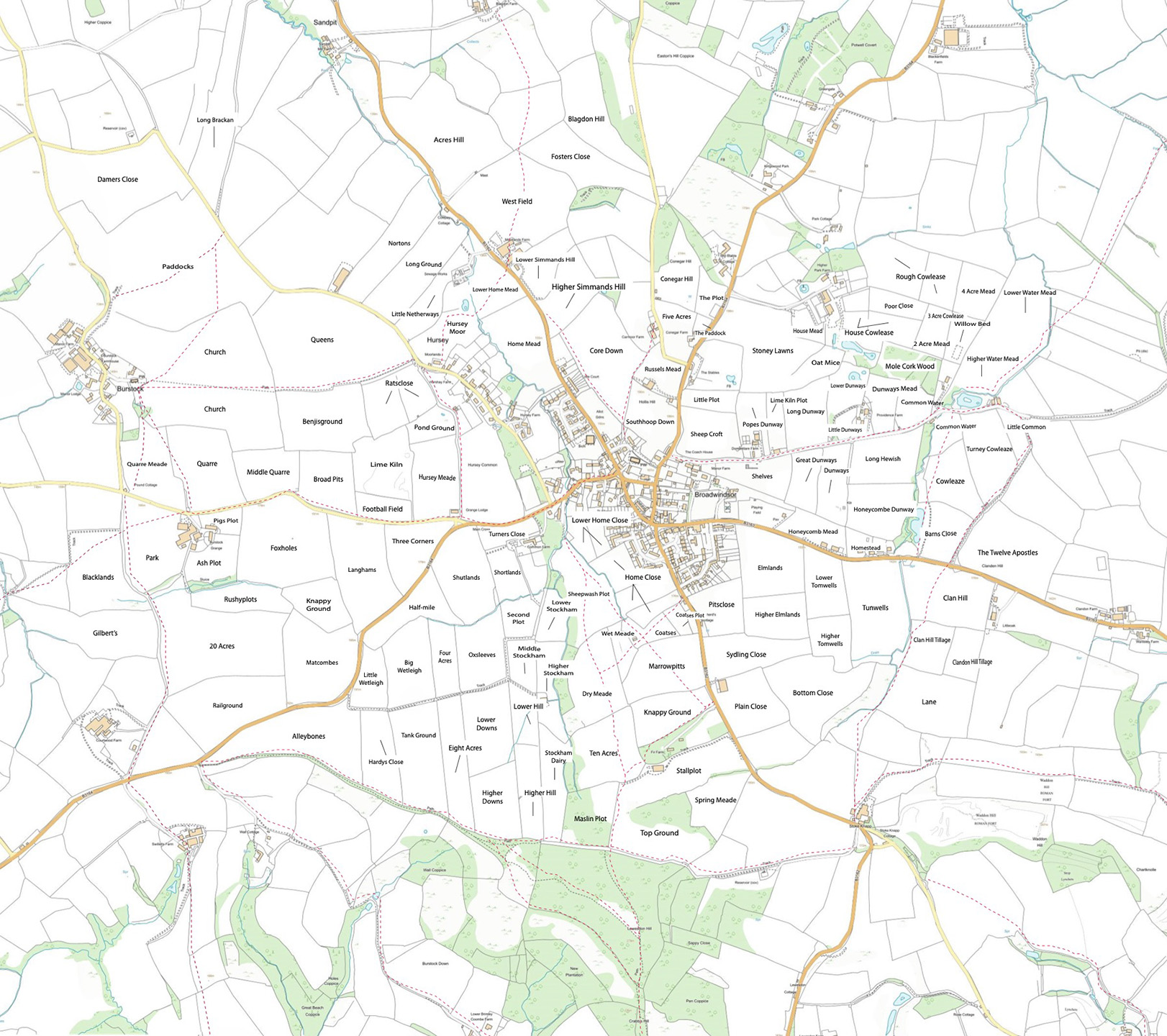
Local folk songs and present-day field names were collected as part of the project, which culminated on 12 February 2022 with the unveiling of an interpretative village map by artist Megan Edwards, whose family home looks out on to Lewesdon Hill.
The map, which is to be installed in a central, exterior location in the village, was unveiled by local couple Barry and Denise Dennett.
Both keen walkers, the Dennetts have lived in the area all their lives. They probably know the fields, paths and lanes around Broadwindsor better than anyone. Poet Peter Roe, who lives in the village, is working with the primary school to create poems that celebrate the village. And Broadwindsor Girl Guides photographed what they loved about the community.
Megan’s lovely map will continue to be a lynch pin of The Place I Love, with seasonal updates made available online.
For up-to-date information about the village, visit broadwindsor.org
The inspiration for the project
When Windrose team member Margery Hookings first came up with the idea of mapping the present-day field names in Broadwindsor, the project’s working title was Out In The Field.
One of its inspirations was Ten Acres, the field where a bench in memory of farmer Michael Frampton was installed after his death in 2020.
From this point just below Lewesdon Hill, there is a magical view of the village nestling into the fields against a backdrop of the landscape as it recedes into Somerset and Devon.
As a farmer’s daughter, Margery knew that all fields had names. She was keen to be acquainted with those in the Dorset village where she has lived since 2001. Although Somerset-born, Margery’s 9th great grandfather, Henry Stanton, was born in Broadwindsor in 1640.
Her first port of call was Dorset History Centre which provided her with the Broadwindsor tithe map of 1840 and list of apportionments.
The document is arranged alphabetically by surname. When she printed it, the list came out in reverse order. The first name she saw was William Stanton, one of her ancestors, who was still running the old Rose and Crown public house at Birdsmoorgate at the time of the 1856 inquest into the death of John Brown. [John’s wife, Martha Brown, was convicted of his murder and was the last woman to be hanged publicly in Dorset.]
The Place I Love project has since evolved from its initial inception to incorporate a number of different strands.
And while it may have ended officially, various spin-offs have emerged, complementing work going on around local trails within the wider group parish and the establishment of closer links between the primary school and the wider community.
Field names around Broadwindsor
‘Many town dwellers are surprised to learn that every piece of land under cultivation bears a name of its own. Although the casual visitor to the countryside seldom hears these names, they are in constant use by those (in any sense) who live by the land. The names are more frequently used in speech than in writing.’ John Field (1972) English Field Names; A Dictionary, The Pitman Press, Bath.
Field names can provide fascinating clues to the land uses and landscapes of the past.
For example, the cul-de-sac in Broadwindsor called Orchard Mead was named after the land where it was built, which is confirmed by the field name on the 1840 tithe map.
Many field names are self-explanatory, such as Dry Meadeand Wet Meade. Stall Plot has a stall in it, Quarre means quarry, Elmlands would have contained the much-loved and late-lamented elm trees and the word Knappmeans ‘land on or containing a hillock’.
But what of the delightfully-named Twelve Apostles? Twelve trees perhaps?
The present-day field names were gathered by contacting local landowners.
Working with the online mapping resource, Dorset Explorer, volunteer Kenzie Bicher created a map which shows the field names currently in use.
The map will be lodged with Dorset History Centre as a local resource for the future.
 ‘I’ve spent most of my working life in the fields. Fields need names, the farmer is a practical man, going about his work in all weathers, at all seasons, he has to be able to identify his own fields among those of his neighbours. How better could he instruct his men, say in haymaking time than by saying, “We’ll turn Bowery today, and start mowing Churches Hill.” Everybody knew exactly where to go.’
Leonard Studley (1990) My Story of nigh eighty years in the Broadwindsor area of the hill country of West Dorset, Creeds the Printers, Broadoak.
Local folk songs
Singer Amanda Boyd was given a brief to find folk songs evocative of country life and working with the land to sing at the project’s final event on 12 February 2022.
The Vaughan Williams Memorial Library’s folk song archive was the main resource to research songs.
All the songs listed from in and around Broadwindsor were researched and three were chosen from Henry Hammond’s Collection.
They were Oxen Ploughing, As I Walked Forth One May Morning and The Jolly Ploughboys, collected by Henry in Beaminster in June 1906.
In the songs’ narrative there are words such as reap, ear and sheafs. These explain the process of growing corn, ploughing the land, working with oxen and the conditions farmers worked in.
It’s important to name the singers as much as it is to remember the songs.
Tom Poole sang Oxen Ploughing, Sam Dawe sang, As I Walked Forth One May Morning. He was aged 81 at the time. A tune for The Jolly Ploughboys was sung by Sam Gregory. But Henry did not note a text from him, so Amanda used words from 1905 from another past Dorset resident, Jacob Baker, Bere Regis.
As I Walked Forth One May Morning touched the heart of West Country pianist and composer Andrea Monk. She was inspired to write a three-part harmony for The Place I Love finale.
For more information about songs contact Amanda at www.mrspricesparlour.co.uk
The Place I Love film
 As part of the project, Windrose’s resident cameraman James Harrison captured the opening and closing events of The Place I Love, with a special emphasis on what the community loves about Broadwindsor and the local landscape that surrounds the village.
The film features local people talking about their love for Broadwindsor and its surrounding countryside, along with poetry from Peter Roe and artists inspired by life around the village, together with local folk songs performed by Amanda Boyd.
Megan Edwards, who created The Place I Love map describes how she was invited to bring to life the field-names inspired plan of Broadwindsor.
And Margery Hookings explains more about the inspiration for the project and how she hopes it’ll encourage other communities to think about the place they love.